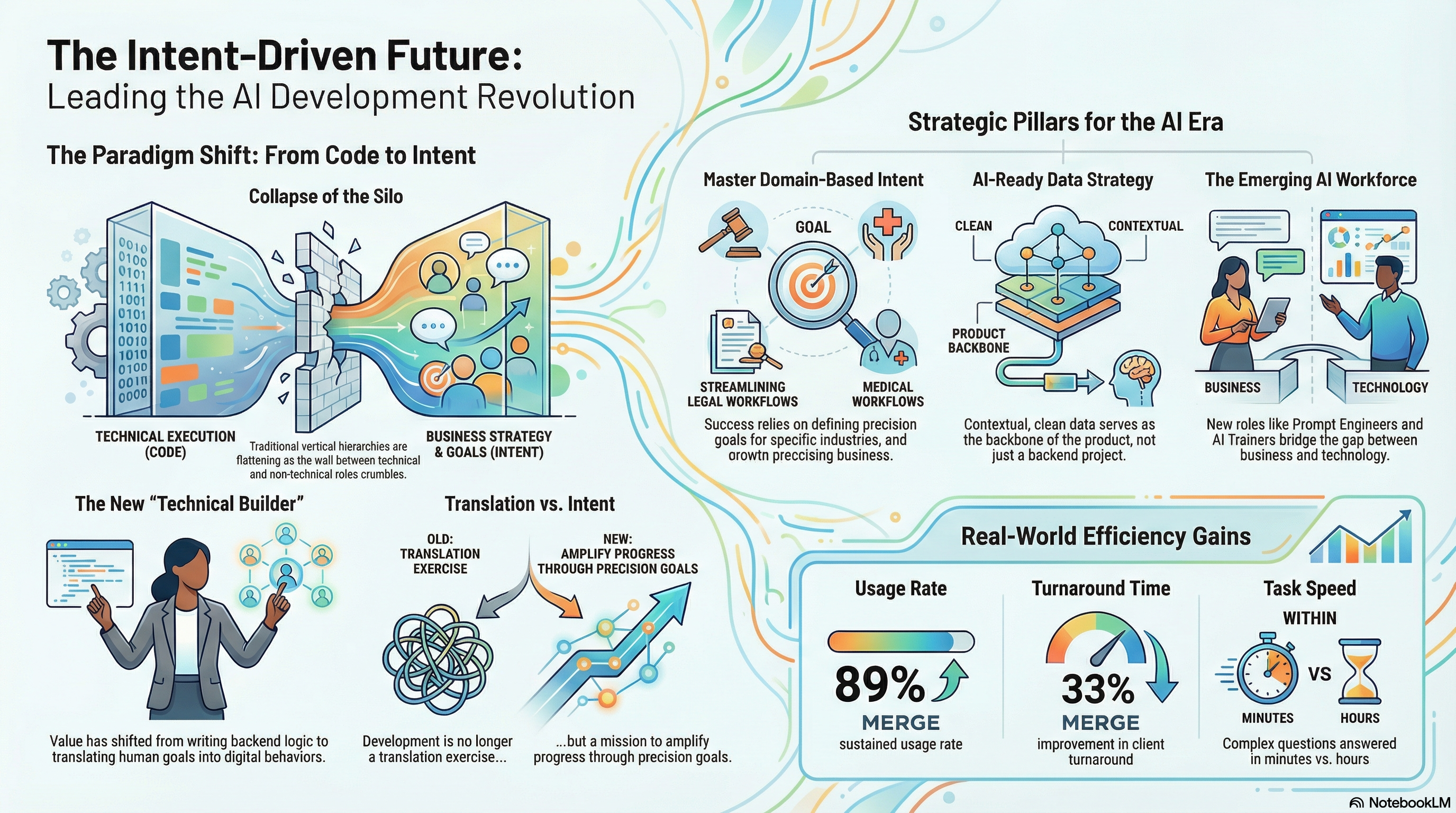
The landscape of technology is shifting beneath our feet. We are moving away from an era where “building” meant painstakingly translating rigid technical requirements into lines of static code. Today, we are entering the age of intent-driven development, where AI serves as the intelligent engine and human intent provides the high-octane fuel.
For Product Managers, VPs, and technical builders, this isn’t just a change in tooling—it is a fundamental evolution in how we conceive and deliver digital value.
The Collapse of the Silo: A Flattening World
The traditional software lifecycle was built on a series of hand-offs, often resulting in a “translation gap” between a user’s need and a developer’s implementation. In that world, domain expertise was siloed: the business side defined the what, and the technical side figured out the how.
However, we are currently witnessing a collapse of traditional domain-based positions. The typical, vertical org chart is flattening. As AI becomes the foundational layer of product development, the wall between “technical” and “non-technical” roles is crumbling.
The new “technical builder” isn’t necessarily the person writing the backend logic; they are the Product Owners and Technologists who deeply understand domain-based intent. Their job is to translate human goals into digital behaviors, ensuring the AI acts as an amplifier of progress rather than just another feature. In this flattened hierarchy, the most valuable skill is no longer just technical execution, but the ability to precisely define the specialized intent of an industry.
The Three Pillars of Modern AI Strategy
To navigate this new, flatter landscape, leaders must focus on three critical areas:
1. Mastering Domain-Based Intent
In the past, you needed to know how a computer worked. Now, you need to know exactly what you want to achieve. Success in the AI era relies on a leader’s ability to define precision goals. Whether it’s streamlining legal workflows or optimizing medical diagnostics, the real value is found in the precision of the intent.
2. An AI-Ready Data Strategy
AI is only as intelligent as the data it consumes. A robust, AI-ready data strategy is no longer a “nice-to-have” backend project; it is the backbone of the product itself. Without clean, contextual data, even the most advanced models fail to deliver tangible business benefits.
3. Emerging Roles in the Ecosystem
The rise of intent-driven products has birthed an entirely new workforce that sits at the intersection of business and tech:
- Prompt Engineers & AI Trainers: The architects of model interaction.
- AI Consultants & UX Designers: Specialists who ensure that “intelligent” products feel intuitive, not intrusive.
Efficiency in Action: Real-World Impact
This shift isn’t theoretical—it’s already delivering significant results for companies that have embraced a flatter, intent-driven methodology:
- Builder.io
:
By utilizing AI to bridge the gap between design and production code, Builder.io enables teams to turn visual intent into functional web components instantly, drastically reducing traditional development cycles. I collaborated with builder.io agents to generate a React SPA using a single mock design image. The project was deployed to AWS S3 using the aws-cli, with human in the loop instructions in OpenCode. Groq’s qwen3-32B helped Plan the deployment and generated the Cloud Formation template. The site is hosted here. - MERGE
:
Achieved an 89% sustained usage rate and improved client turnaround times by 33% through AI-powered templates. - WITHIN
:
Reported a dramatic reduction in manual task time, allowing their team to answer complex client questions in minutes instead of hours.
The Engine is Ready
AI development has fundamentally shifted from a translation exercise to an intent exercise. The future is being shaped by those who can look at a domain, identify a core intent, and use AI to accelerate that outcome.
For the modern product leader, adaptability is the ultimate competitive advantage. By maintaining an AI-ready data strategy and focusing on specialized, intelligent solutions, we can unlock possibilities that were previously out of reach. The engine is ready; it’s up to us to decide where it’s going.